 Free and open source
Private AI research, with every source attached.
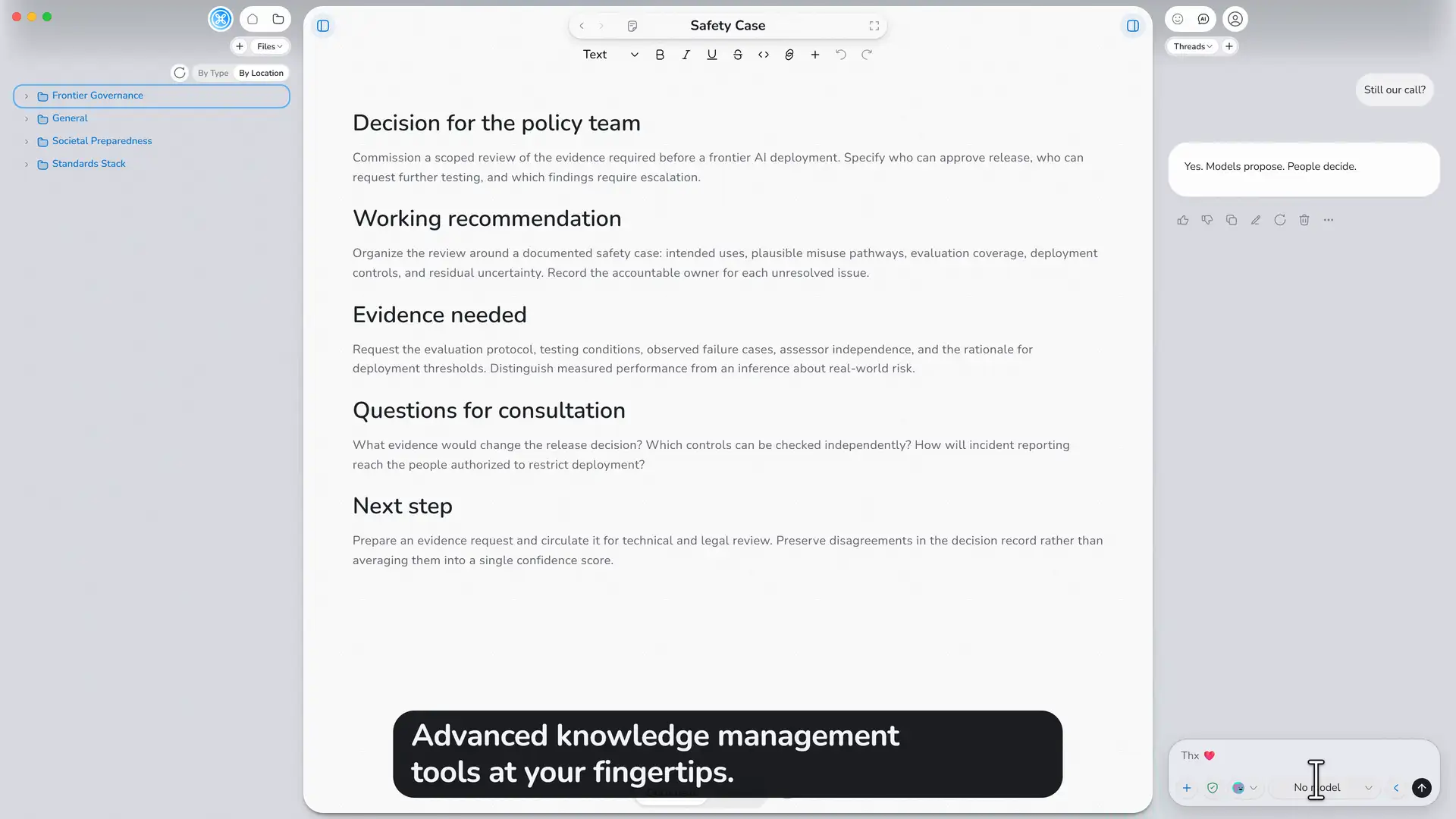
Sensitive AI safety and policy work should not have to pass through a vendor server to get an answer. AIR Office is a desktop application: your collections, notes, and review records are files on your own disk, and you choose per request which model runs the inference.
Your work stays on your disk
Collections, notes, chat history, and review records are files on your own machine. There is no account to create and no server holding a copy, so a policy draft or an unpublished evaluation is not logged anywhere before you decide it is sensitive.
Embedded AI harness safety
The agent runs inside the application, on your machine, under settings you control. Four of those settings decide what the harness is allowed to do.
You choose the model each time
A local model runs on your hardware and the request never leaves it. A hosted provider runs it under your own key, whether that is OpenAI, Anthropic, or another endpoint you configure.
You approve what runs
In Settings and in chat you decide which tools may act, and whether a change waits for your approval first.
You grant access folder by folder
Connecting a folder authorizes that folder only. Disconnecting it does not delete your files.
You can take it all with you
Notes, conversations, and whole workspaces save in readable formats, so the record outlives the application.
How it differs from a hosted workspace
Notion AI and Microsoft 365 Copilot are capable workspaces. They are also hosted services, so the record lives on their infrastructure and the model is theirs to choose.
| AIR Office | Notion AI | Microsoft 365 Copilot | |
|---|---|---|---|
| Records live | Your machine | Notion cloud servers | Microsoft cloud, tenant-bound |
| Model choice | Local endpoint or your own keys | Notion's integrated AI | Microsoft-managed |
| Standards preloaded | EU AI Act, NIST AI RMF, NIST GenAI Profile, OECD AI Principles | None | None |
| Review workflows | Policy Auditing, Quality Improvement, Meta-Evaluation | Not built in | Not built in |
Standards arrive with their edition
Reference collections for the EU AI Act, the NIST AI Risk Management Framework, the NIST Generative AI Profile, and the OECD AI Principles ship with the workspace. Each records its edition and its source.
Development and evaluation work is covered by companion collections for UN SDG goals, OECD-DAC evaluation, and UNDP digital public infrastructure guidance. A memo can cite the version it was checked against, and a reviewer can confirm the clause still says the same thing next year.
Security is checked, not assumed
Open source means the code can be inspected, and we inspect it before shipping. Every release passes through five checks, and a check that did not finish counts as a failure rather than a pass.
TruffleHog finds leaked secrets and credentials.
Trivy finds vulnerable dependencies and misconfiguration.
Semgrep scans our own source for risky patterns.
CodeQL runs deep semantic analysis over the codebase.
SkillSpector evaluates the Lab skills that ship with the app.
Local-first data sovereignty
Sovereignty is a claim you have to be able to answer for, usually to someone else. Two questions cover most of it.
Where does the work live?
In files on your own machine, under your own account or none at all. Not in a workspace someone else operates.
Who else can see it?
Only a provider you named, only for a request you made, and only the part of the record that request needed.